Assessing Kenya's Industrial Capacity To Support Construction and Operation of It's First Nuclear Power Plant
A Research Study by Desmond Trevor Nyalwanda Otieno
GE-EBK, MEng. Student in Energy and Power Engineering
Department of Engineering Physics, Tsinghua University, China
How Nuclear Power Works
Understanding the technology behind nuclear energy generation
How Nuclear Power Plants Work
A nuclear power plant generates electricity through a controlled nuclear chain reaction. This process involves multiple interconnected systems working together to convert nuclear energy into electrical power.
⚛️ Nuclear Fission: Heat from Splitting Atoms
Inside a nuclear reactor, uranium fuel pellets are packed into metal rods within the reactor core. When a neutron strikes a uranium-235 atom, the nucleus splits apart in a process called fission. This releases a burst of heat energy and additional neutrons, which trigger more fissions, creating a self-sustaining chain reaction.
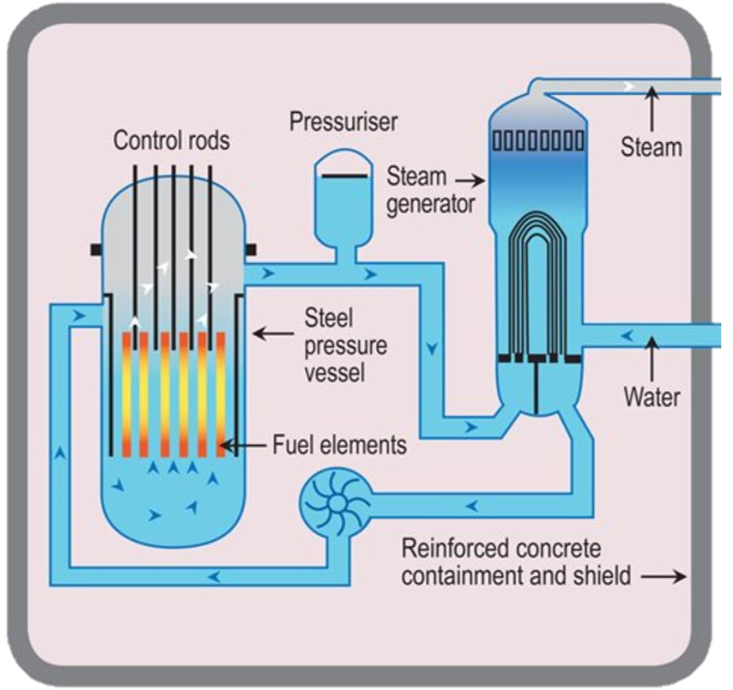
Simplified diagram illustrating the operation of a pressurised water reactor. Source: World Nuclear Association
♨️ Primary Circuit: Containing the Heat
The heat from all the fission chain reactions is absorbed by water or another coolant flowing through the primary loop. This coolant is kept under high pressure, allowing it to stay extremely hot without boiling, much like a supercharged pressure cooker; only the pressure is about 150 times the atmospheric pressure. Meanwhile, control rods made of neutron-absorbing materials (such as boron or cadmium) adjust the reaction rate.
💨 Secondary Circuit: Steam from the Heat
The hot coolant passes through a steam generator, transferring its heat to a separate water system in the secondary loop. This water turns into high-pressure steam without ever mixing with the radioactive primary coolant.
⚡ Electricity Generation: From Steam to Power
The steam rushes through massive turbines, spinning them at incredible speeds. These turbines drive a generator, converting mechanical energy into the electricity that powers homes, industries, and technology.
Cooling System: Completing the Cycle
After passing through the turbines, the steam is cooled back into liquid water in a condenser. This cooling often relies on water from rivers, oceans, or the cooling towers that releases non-radioactive vapor. The water is then cycled back into the system.
Key Takeaway
A nuclear power plant consists of three key islands (sections):
- Nuclear island - Is where fission takes place inside a reactor. The island also contains primary cooling system pumps, and safety systems including huge tanks containing water.
- Turbine Island - Houses the steam turbines and generator
- Balance of Plant - Includes secondary cooling systems, electrical switchyards, and support systems. Beyond the nuclear island, the process resembles conventional power plants that ultimately use heat to create steam that drives turbines and generators.
Overview of Nuclear Electricity Generation
A typical nuclear power generation capacity can have multiple reactors.
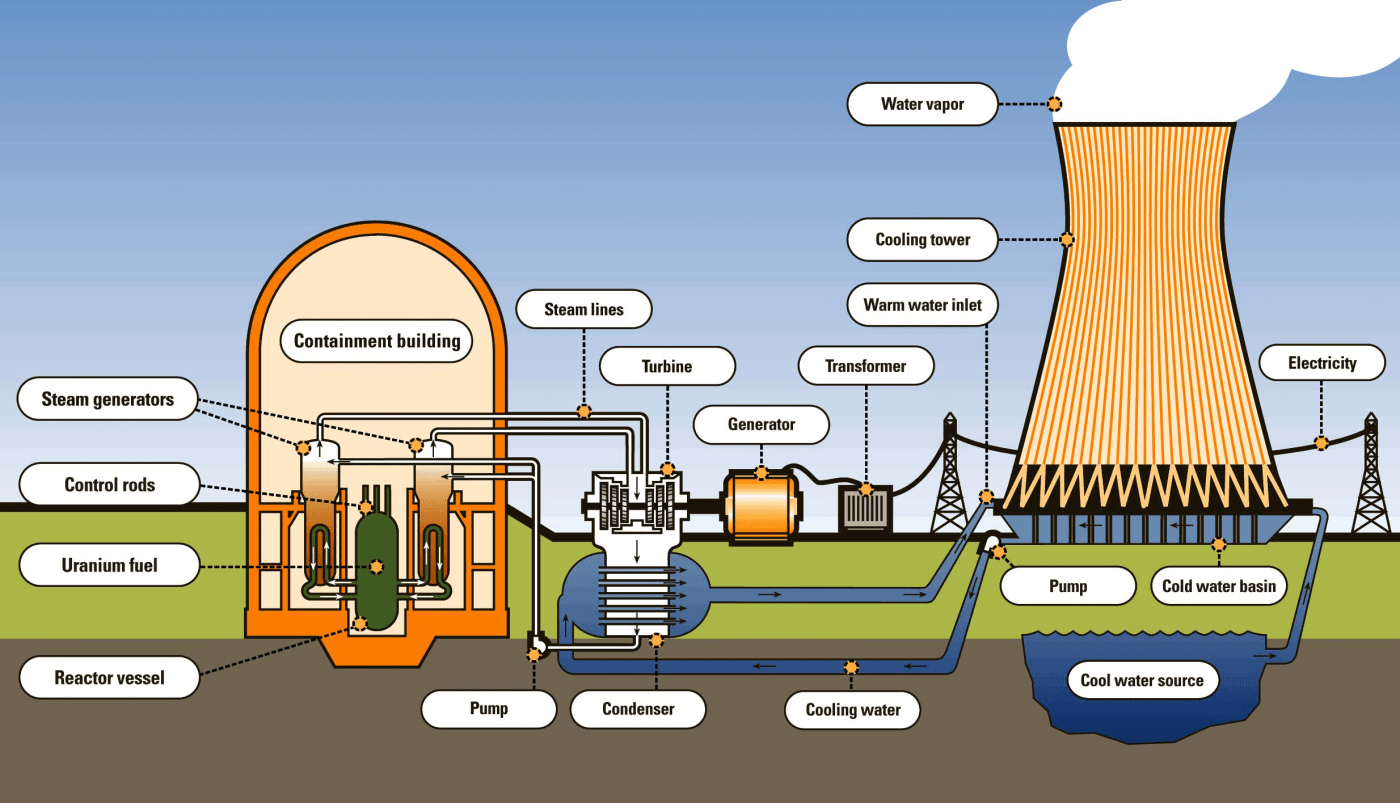
Simplified diagram illustrating the operation of a nuclear power plant. Source: Foro Nuclear
Vision 2030, 2034: Kenya's Strategic Path to Nuclear Energy (Adapted from NuPEA)
Official data and strategic planning regarding Kenya's journey towards nuclear power adoption.
For official national progress updates and critical documentation, please refer to NuPEA at nuclear.co.ke.
Increasing Energy Demand
Kenya's economy is growing, and with it, the demand for electricity. Historic peaks in electricity demand reached 2,362.28 MW in July 2025.
Security of Supply
Nuclear power offers stable, continuous "baseload" energy that can run day and night, providing crucial reliability.
Cost Stability
The cost of uranium fuel is a small fraction of the total cost, offering protection against fossil fuel price volatility.
Environmental Sustainability
Nuclear power produces zero carbon emissions during operation, supporting Kenya's commitment to clean energy and climate goals.
Key Milestones on Kenya's Nuclear Journey (Source: NuPEA)
Detailed information on these milestones can be found on the official NuPEA website.
National Priority Status
NESC recommends nuclear power as a national priority.
Phase 1 Completion (Readiness)
Completed Phase 1 of the IAEA Milestone Approach (Ready to Make a Knowledgeable Commitment).
Project Tender (Target)
Targeted date for issuing the tender for the first nuclear power plant (NPP).
First Concrete/Construction (Target)
Key milestone for starting physical construction of the first NPP.
First Grid Connection of 300 MW NPP (Target)
Key milestone for integrating nuclear power into national grid
Commissioning of 300 MW NPP (Target)
Expected operationalization of the first nuclear power plant
Current Status: Phase 2 of IAEA Milestone Approach
At Phase 2 of IAEA's milestone approach for nuclear power development, Kenya is currently doing preparatory Work for Construction. For the latest official progress reports, please refer to NuPEA at nuclear.co.ke.
- Industrial capacity assessment and development
- Finalizing the legal framework
- Conducting comprehensive site evaluations
- Developing human resource capacity
- Establishing robust regulatory systems
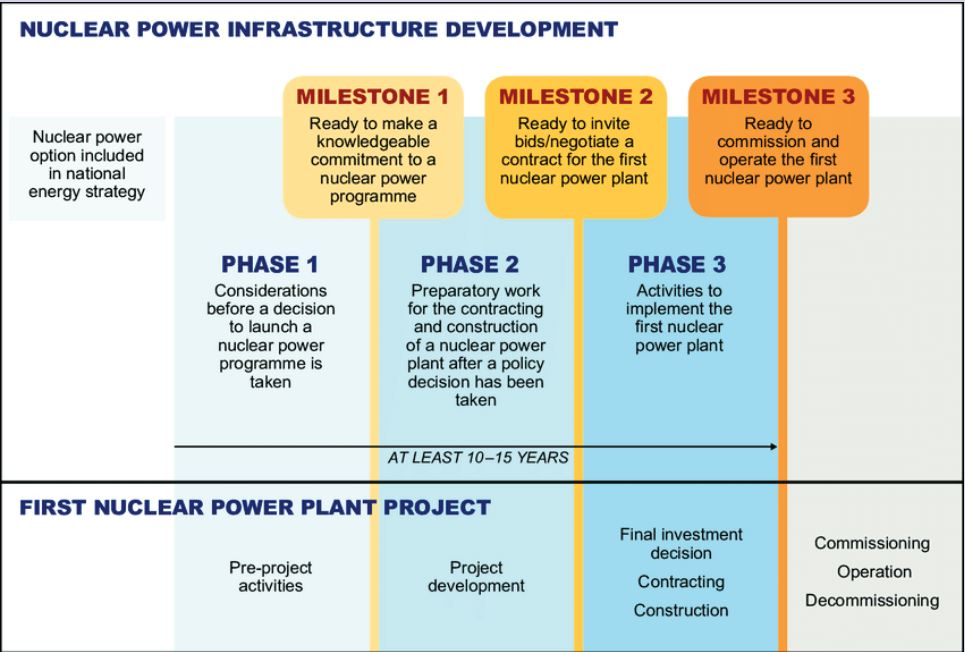
Kenya's Progress according to the IAEA milestone approach, currently at Phase 2. (Adapted from NuPEA documentation)
Supply Chain Opportunities
Numerous specialized services will be required for Kenya's nuclear power program
Researcher Contact
Desmond Trevor Nyalwanda Otieno
Collaborating Institutions
- Nuclear Power and Energy Agency (NuPEA)
- Tsinghua University
- China National Nuclear Corporation